Buffalo, New York. Two kids. I switched to a smaller phone in 2022 and I write down what worked and what didn't.
The first one
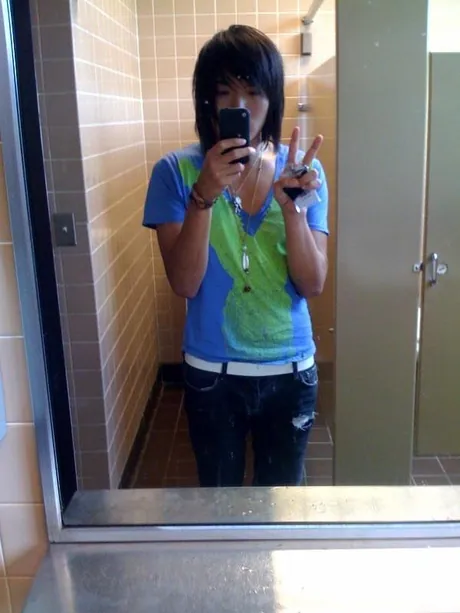
me with the original iPhone, being a loser
I watched Steve Jobs unveil the iPhone live in January 2007 and I could not wait. I was on my
parents' family plan at the time, so I went off on my own to Cingular, which was the only
carrier that had it, just to get one. There was no App Store yet. There were no apps in the
sense anyone means now. What there was, was Mobile Safari, the whole internet in your pocket
with a screen you could pinch, and that was my way in. I never looked back, and for about
fifteen years I didn't want to.
I say this so you know I'm not writing from the outside. I loved that phone. I loved most of
the ones after it. Nothing here comes from someone who never got it.
The in-between generation
me and Toby
Millennials landed at an odd spot in the timeline. I went through high school with a basic
flip phone, dial-up at home, and a social internet that was mostly a buddy list. Then the
connected world arrived while we were coming of age, and we grew up with it in real time. Our
parents were already adults with formed habits when the smartphone showed up. The kids after
us have never known a room without one. We're the only group that remembers both sides
clearly, which makes us a kind of control group, and it means the question "what was it like
before" has an answer we can give.
The answer, for what it's worth, is that before was slower and I was more bored and I read
more and I was more often exactly where I was. That is roughly what this site is about.
Why I switched
My son was born in 2020 and my daughter in 2022, and somewhere in there I noticed that I was
checking messages, likes and email constantly, and that a lot of the moments I thought I was
capturing I wasn't in. I was taking photos of my kids more than I was looking at them. Those
blink-and-you'll-miss-them years were going by on the other side of a screen.
exploring new hobbies
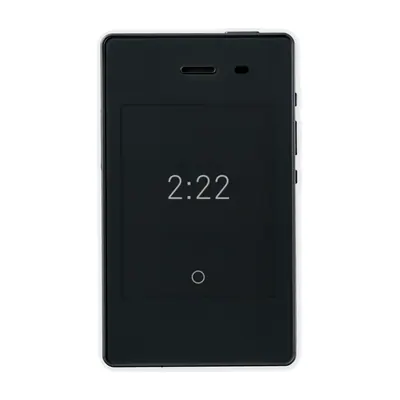
So I bought a Light Phone II. It was one of the better decisions I've made. The first weeks
were strange: long runs with no music, waiting rooms with nothing to look at. Then it got
good. I picked up 35mm film photography. I read more and wrote more. The runs without
headphones turned into something close to meditation.
What a phone is
This took me longest to see. A smartphone is fifteen objects that used to live in different
drawers, glued together and sold as one. That's the whole trick. You pull it out to check the
time and the other fourteen things come with it: the inbox, the news, the feed, the game, the
store. You can't use one without being offered all of them. Every check is a lobby with
fifteen doors.
Downgrading is un-gluing. You give each job back to a thing that does only that job. Some of
those things cost twenty dollars and some you already own. A few you'll find you don't need at
all. This is how it shook out for me, in a pile on the desk.
The cameraA 35mm point-and-shoot, one roll a month
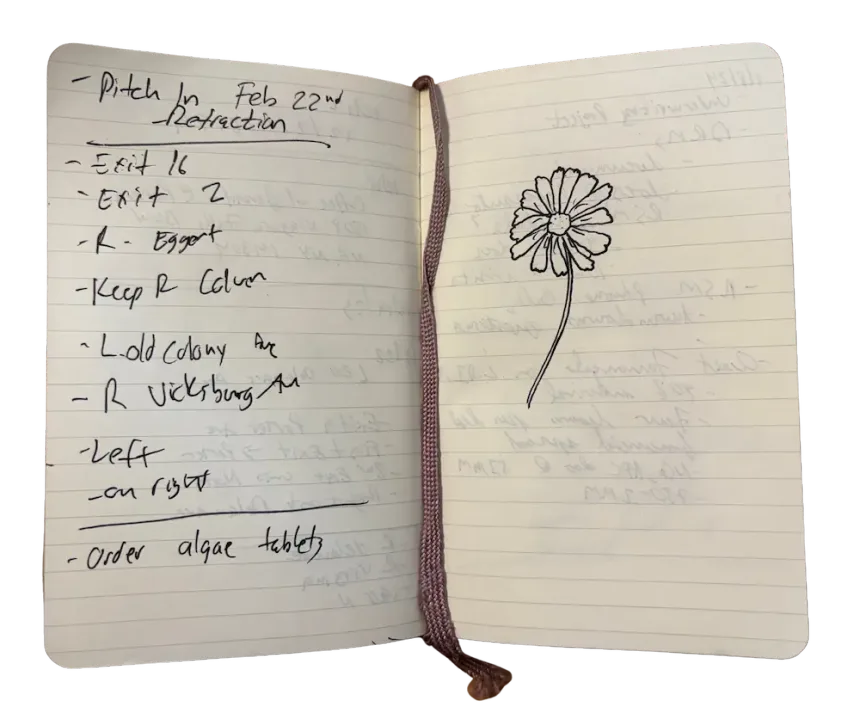
The mapDirections copied down before I leave
The WalkmanRecords at home, nothing on the run
The alarm clockA ten-dollar clock by the bed
The calendarA paper planner, and the computer
The newspaperThe weekend paper, on the step
The mailboxEmail at a desk, twice a day
The flashlightOne on the keys, one in the car
The calculatorThe dumbphone has one
The walletCards, in a wallet
The notebookA pocket notebook and a pen
The watchA watch
The jukeboxAn album, start to finish
The Game BoyA secondhand one, and Snake in a pinch
The libraryA library card, in person
The phoneStill the phone. That part it kept.
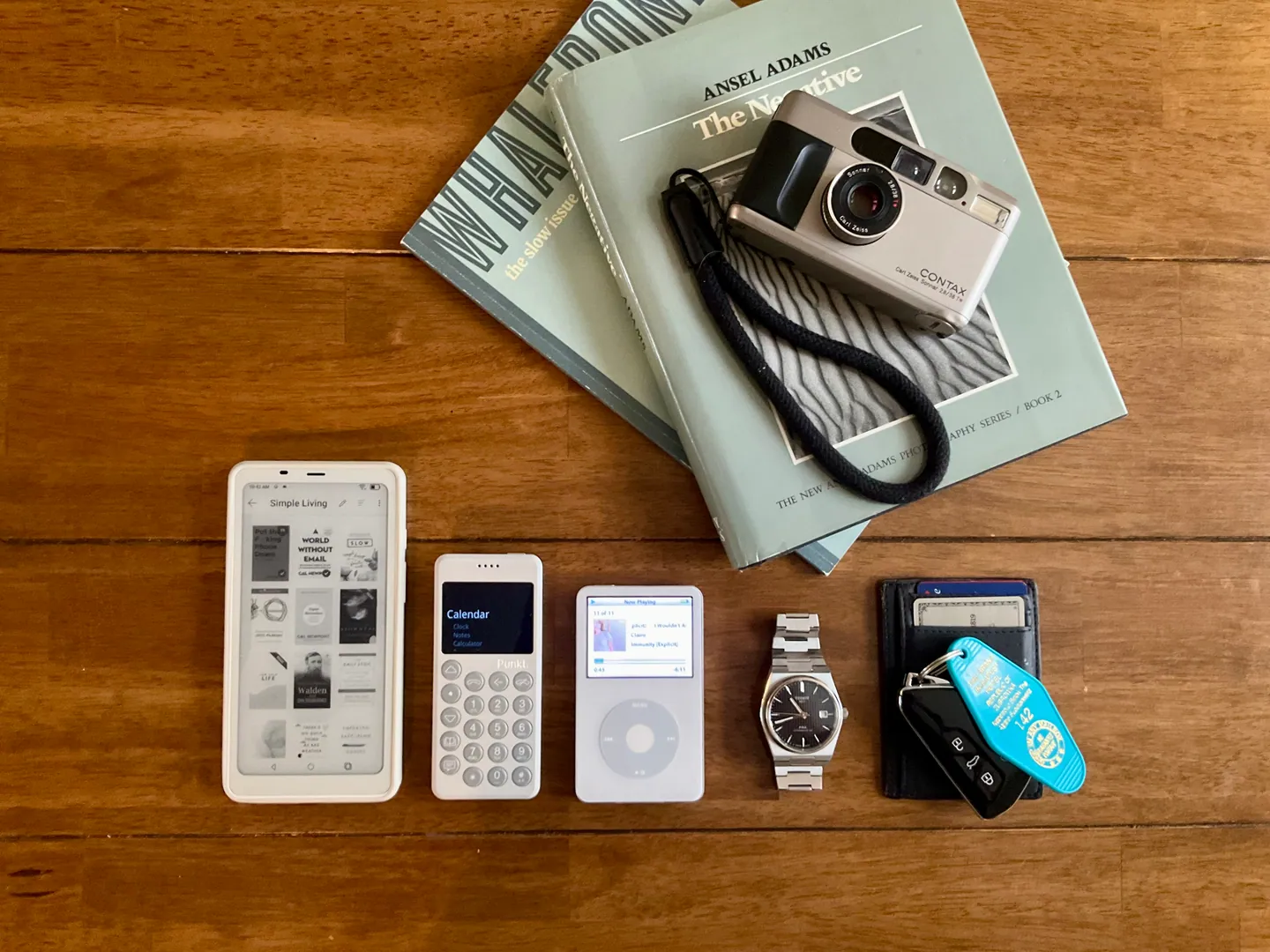
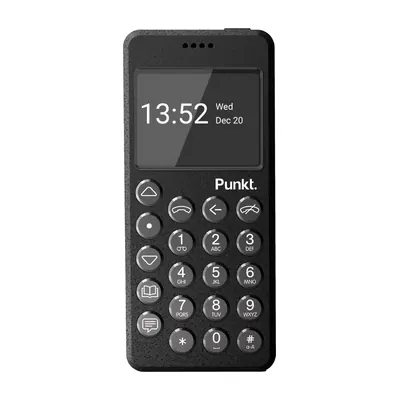
an old EDC: Boox Palma, Punkt MP02, iPod, automatic watch, Contax T2 camera (a little
pretentious, I know)
The parts that are hard
Anyone who tells you this is painless is selling a phone. Some things are harder on a small
phone, and a few are close to impossible because the world has quietly decided everyone has a
smartphone. I'd rather you know them going in. This is my list, and what I do about each.
Two-factor codes
Some logins want an app on a smartphone. Text codes work on any phone, a hardware key like a Yubikey works on a computer, and a few dumbphones have a browser that can get through. The one that only takes an app is the reason a lot of us keep a backup.
Banks and payments
A few banks are app-only now. Mine has a website. Check yours before you switch, and if it fails the test, that is a reason to switch banks as much as a reason to keep the phone.
Tickets, parking, chargers
Arena tickets that only exist in an app, parking meters that want you to scan something, restaurant menus behind a QR code. This is the part that is genuinely getting worse, and calling the venue to ask for the alternative is the only fix I know.
The group chat
WhatsApp needs a smartphone to verify itself every so often. iMessage and most of the rest work from a computer. The group chat that feels urgent usually isn't, but the one that plans the kids' soccer carpool sort of is.
A city you don't know
At home I don't miss the map. In a new city I write directions down, read signs, and ask people, and I get a bit lost and find it more interesting than I expected. On a work trip with a tight schedule, I take the iPhone.
Rides and travel
Ride-share is the one I miss at airports. A taxi stand still exists at most of them. Boarding passes print. A cellular watch can carry a boarding pass and call a car, which is why it is in the database.
Which brings me to the confession most of us make eventually: I keep a backup. Right now my
daily setup is the dumb.co Dumbphone 2 paired with an iPhone Air that stays home or in a bag
for the handful of things above that still need an app. I'm not a purist about it. Some weeks
the iPhone wins. The backup has a real cost, and the cost is that every day you have to decide
again whether to carry it. If you can live without one, you'll find the whole thing easier. If
you can't, put it somewhere inconvenient and make it an old, slow one.
Why willpower loses
I tried the moderate route first. Screen time limits, gray screens, apps deleted on Sunday and
reinstalled by Wednesday. I'm a fairly disciplined person and I lost every round, and I've
come to think that's the expected result. The thing in your pocket was built by very good
engineers to be picked up, and you are not going to out-discipline a budget that size. The
alternatives page exists because those steps help, and I'd try
them first. But a smaller phone is a different kind of move: one decision instead of a
thousand small ones a day, and it stops the argument you keep having with yourself.
If you've set rules and broken them, that's the product working as designed. The research page has what the studies say, caveats and all.
What I do with the time
directions, written down before I left
People ask what I do with the time, as if the point were to fill it. A lot of it I fill with
nothing. I sit on the porch. I stand in a line and think about dinner. I do read more and I do
take better photos, and the things to do page
is a list of what I tried. Treat it as options. The hours you get back don't owe anyone
anything. The change I notice is that I'm present for more of my own life, including the
boring parts, and the boring parts turn out to be where the good ideas were hiding.
Since then
A few years and a lot of phones later, I've used most of what's in the database at one time or
another. These are the ones I've lived with for more than a month.
Two movements shaped how I think about this. The Slow movement, which grew out of Carlo
Petrini's 1986 protest against a McDonald's opening at the Spanish Steps in Rome, argues for
doing fewer things at a pace where you can taste them. It's where this club takes its name.
Essentialism, Greg McKeown's name for the disciplined pursuit of less, argues for cutting the
trivial many to make room for the vital few. A dumbphone is a small, physical way to practice
both. It forces you to decide what you need from the thing in your pocket.
Privacy is part of it too. A phone that can't run apps collects a great deal less about you,
and that's a quieter kind of freedom that I've come to value more each year. It's also why
this site runs no trackers and why signing in, if you ever want to rate a phone, is a code
sent to your email and nothing else.
How I keep the data honest
Every phone in the database has a list of sources and a last-checked date. Where I couldn't
confirm a spec from the manufacturer, the field says unknown rather than guessing. Prices
drift, and I fix them when I notice. Nothing here is sponsored: no maker has paid to be in the
database, to be left out of it, or to have a word of their entry written a particular way. I
am in three affiliate programs: Light's, on the buy link for the three Light phones, Amazon
Associates, on the Amazon link where a phone or a book is sold there, and Bookshop.org's, on
the reading list. Each of those links is labeled where it appears, buying through one costs
you nothing extra, and none of them has any bearing on what an entry says or on the fact that
phones and books I think are better sit next to the ones that pay. Reviews from other owners
are read by a person before they show, and the first thing I check is whether the reviewer
sounds like they've held the phone. If you spot an error, or you make a phone that should be
listed, email me at
hello@slowerliving.club, or use the suggestion form at the bottom of
the database.
Questions I get
Q.
So are you a luddite?
The Luddites were English textile workers who broke the new knitting frames around 1811. They understood the machines fine. The argument was about who the machines were for, and what happened to the people already doing the work. Two centuries later the word gets thrown at anyone who cannot set up a printer.
If the older meaning is on offer, I'll take it. Ask what a piece of technology costs you, ask who collects the benefit, then decide. Often the answer is yes. I built this site, and there's a computer in the next room I'd be lost without. What I stopped doing is taking the whole bundle because it arrived in one box.
Q.
Doesn't that make you hard to reach?
Less than people expect. The phone rings and texts land, which covers most of what reaching someone means. Email waits for a desk, so a reply takes hours instead of seconds. I told the people who needed to know once, and nobody has minded since.
In an emergency I'm easier to get hold of than I used to be, because the phone is boring enough that I notice when it goes off. The real gap is a group chat that lives only inside an app. Sort that one out before you switch.
Q.
Do I need a dumbphone to be here?
No, and most people shouldn't start there. The alternatives page is nine changes to the phone already in your pocket, all of them free, and for a lot of people that is the whole fix. A smaller phone is the move for anyone who has tried that and keeps losing.
If you want to test it, a $20 keypad phone on a second line for a weekend tells you most of what you need to know, and you're out twenty dollars if the answer turns out to be no.
Partly, yes, and it's worth saying out loud. A lot of work now arrives through an app: shifts, dispatch, deliveries, the portal a landlord posts to. If your income runs through one, the choice isn't on the table, and nothing I write about attention changes that. It also helps that someone else in my house can hold the app the school posts to, which is a kind of help not everyone has.
The cheap end of this is cheap, though. A keypad phone runs $20 to $60, secondhand ones go for less, and every step on the alternatives page costs nothing. The expensive version is a $400 e-ink phone with a smartphone in a drawer behind it. That one is mine, and nobody needs it to get the point.
Q.
Is this site affiliated with a phone maker, a store or another club?
No, none of them. It's one person in Buffalo with a spreadsheet. Nobody who makes or sells a phone has a say in what the database says about them, and the affiliate links are labeled where they appear.
The clubs are independent of each other too. This site spent its first week calling itself a Luddite Club, then I counted how many clubs already answer to that name and picked a new one. The Brooklyn teens the papers wrote about are their own thing entirely. Start one where you live and it's yours.