How to start a Slower Living Club
A regular, in-person get-together for people who want to live at a slower speed.
A Slower Living Club is two or more people who get together on purpose, in person, on a schedule. That is the whole definition. It can be a walk, a porch, or the room at the back of the library. There are no dues and nothing to sign up for.
People come for different reasons. Some are trying to spend less of the day on a screen, some want one evening a month that nothing else is scheduled on top of. Mostly they want to sit with other people for an hour and a half and not be interrupted.
This guide is for starting your own, wherever you are. It is short because starting one is simple.
What it is
A club is the same people on the same day, most months. One good evening is a good evening. Do it again next month and you have a club.
It happens in person, and so does as much of the organizing as you can manage.
Phones go in one place when people arrive.
It is not
- A support group. People will share, but nobody has to.
- A ban. The phones come back out at the end.
- A brand. There is no official version, and this is only how I would do it.
- A lecture about screens. Everyone there already knows.
- A place to sell anything, courses and newsletters included.
Start with two, then invite
Find one other person. That is your club. Pick a day and a place and go. Do that twice before you invite anyone else, so there is something real to invite them to.
Then tell people. Out loud works best, because the people you want are the ones who will say yes to a person and no to a link.
Ways to invite
- Ask five people to their face. Start with the friend who says they are too busy and the coworker who reads at lunch.
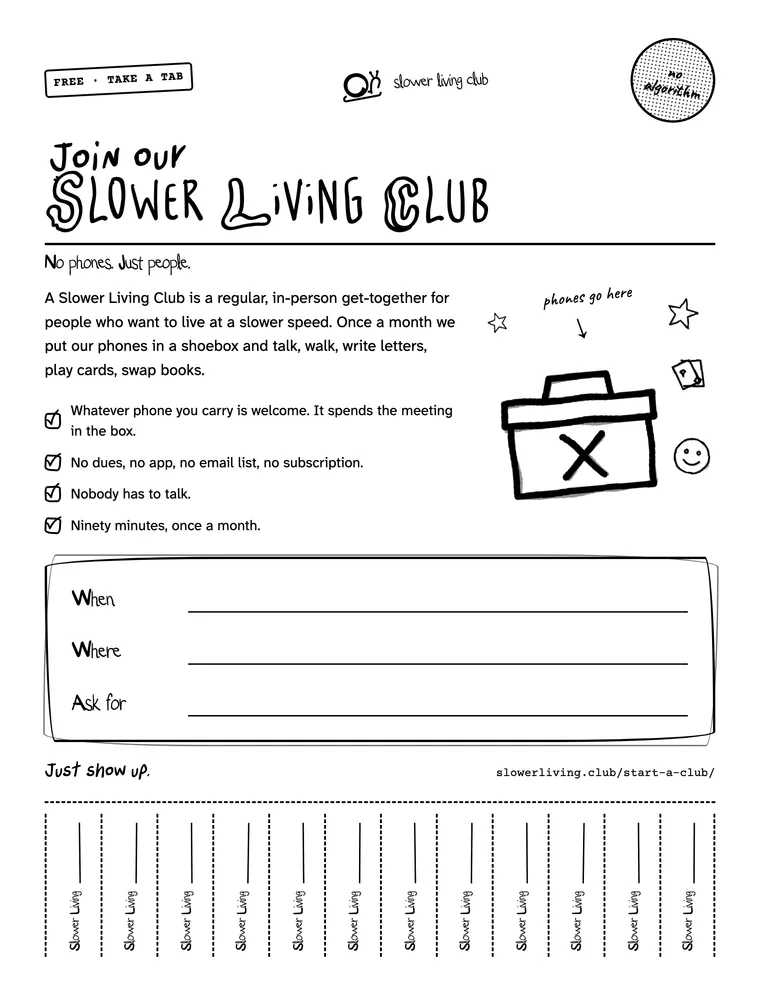
- A paper flyer with tear-off tabs, up at the library and the coffee shop. There is one to print at the end of this guide.
- Ask the library to put it in their events calendar. They will, and it makes it look official.
- The community listings in the local paper, which are still free and still read.
- A group text to the four people who might come, with the date in it, rather than a group chat that lives forever.
- Tell the barista. They know everybody.
Flyer copy you can steal
Slower Living Club, [your town]
No phones. Just people.
The [first Sunday] of every month, [3 to 4:30 pm], [the library, room B].
Everyone welcome. No dues and no sign-up.
Tear off a tab and just show up.
Where to meet
The right place is free or cheap, easy to find without a map, quiet enough to hear each other, and fine with people sitting for an hour and a half. Most towns have five of these.
Good rooms
- A public park, with a bench or a blanket.
- A library meeting room. Free to book, and nobody minds.
- The back table at a coffee shop on its slow afternoon. Everybody buys a drink.
- A community center or a church hall on a weeknight.
- A bar on its quiet night, if the club is adults.
- Someone's porch, kitchen or backyard, once people know each other.
- A bookstore that hosts things. Ask; the answer is usually yes.

When, and how often
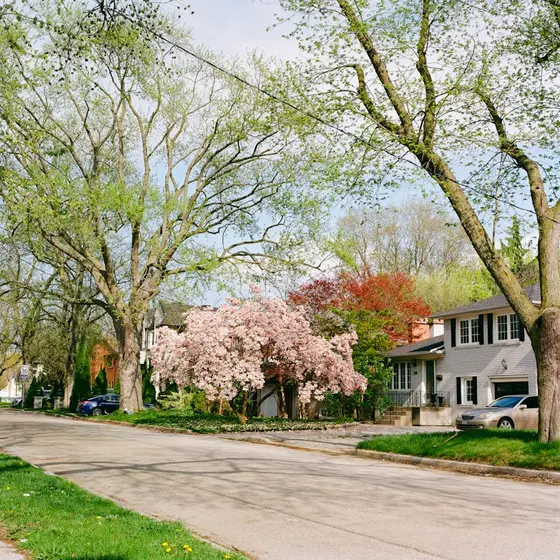
Once a month is the sweet spot. Weekly is a lot to ask, and every other week is the kind of schedule people lose track of. Pin it to something easy to remember, the first Sunday or the last Tuesday, at the same time every month, so nobody has to look anything up.
Ninety minutes. Long enough that nobody feels rushed, short enough that people with kids and jobs can come.
Sunday afternoons and weeknights at seven both work. Pick the one that suits the two of you and let everyone else fit around it. A month is long enough that people will miss it.
How to run a meeting
Someone hosts. They bring the box, say hello to new people, and keep half an eye on the time. Hosting is not running a program. The best meetings feel like a dinner where the host happens to have a plan in their pocket.
- 0:00 Phones in the box A shoebox with "phones" on the lid in marker, in the middle of the table or by the door. It takes ten seconds and it changes the room.
- 0:05 The go-round Your name and one thing from the last month. New people go first so they are done being nervous. Keep it to a minute each.
- 0:20 The thing One topic to talk about or one thing to do, picked at the last meeting. Both lists are on the next pages. Forty minutes, loosely.
- 1:00 Loose time Snacks and side conversations. This part is the club. Do not schedule over it.
- 1:20 Next time Pick the next date, the next thing, and who brings snacks. Write it in the logbook. Then the phones come back out and people go home.
Hosting, in four lines
- New people first, always.
- Nobody has to talk. Nobody gets to talk the whole time.
- Nothing gets sold here, and nobody lectures about screens.
- If the conversation stalls, ask the quietest person what they did last weekend.
Things to talk about
Pick one before the meeting and read it out at the start. Most of them drift into something else within ten minutes, which is the point of picking one.
- What you did with your last free Saturday.
- The last thing you made with your hands.
- What you are reading, and what you gave up on.
- Boredom. When did you last sit all the way through it?
- The hour of the day you would most like back.
- Something you do slowly on purpose. Bread, film, letters, the long way home.
- The one app you can't quit, and what it would take.
- Being unreachable for a day. When did you last try it?
- How you get places now. Your best getting-lost story.
- The things you used to photograph. What happens to a moment when you don't.
- Phones and kids. Yours, or the ones you were.
- Friends who think this is a bit much. What do you say?
- The last time you were early somewhere with nothing to do.
- What you remember about before. What you would tell someone who doesn't.
Things to do together
Not every meeting has to be a conversation. Give people something to do with their hands and the talking takes care of itself.
- A walk with no destination and no map. Turn where the group wants.
- Letter-writing night. Bring stamps and paper. Everyone leaves with something to mail.
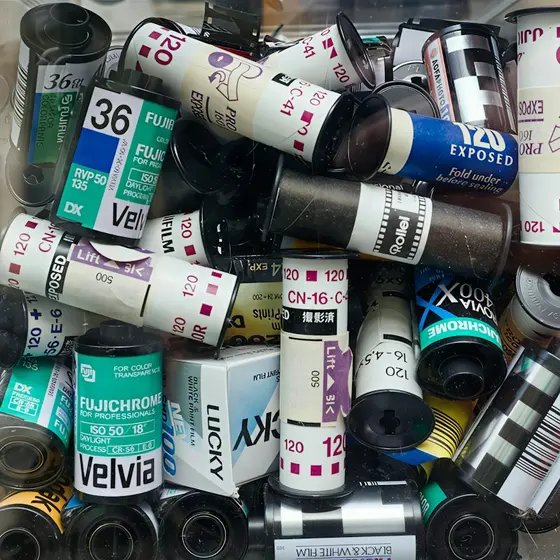
- A photo walk on film or cheap digital cameras. Get them developed and bring the prints next time.
- Silent reading, thirty minutes, then talk about what you read. Bring the book you keep meaning to finish.
- Cards or a board game. Someone teaches one game well.
- A potluck, with the recipe written on a card next to the dish.
- A swap table: books, records, plants, whatever is in the back of the closet.
- A repair hour. Jeans, a lamp, a bike tire, a wobbly chair. One person who knows how, everyone else learns.
- A paper-map treasure hunt across your own neighborhood.
- A record night. One album all the way through, and nobody skips.
- Everybody steps outside and calls someone they have been meaning to call.
- A show or a reading, phones in the box the whole time. Notice how it feels.

House rules
Read them out once, at the first meeting. After that they stay on the lid of the box.
- Phones go in the box. All of them, including the host's.
- Any phone counts. Nobody is graded.
- New people first.
- Nobody has to talk.
- No selling and no lecturing.
- What gets said here stays here.
The kit
Everything a club needs, none of it expensive.
- A shoebox, with tape and a marker for the lid
- A notebook and a pen, for the logbook
- A folding chair, if the park is the room
- Snacks, or a plan for who brings them
- A short stack of flyers with tear-off tabs
- A deck of cards
- A cheap camera, film or digital
- The next date, written down
The flyer
One sheet with tear-off tabs. Fill in the day and the place before you put them up.