Will a dumbphone work on Verizon, AT&T or T-Mobile?
Most of the time the phone is fine. The question is whether the carrier has heard of it.


The short version
- T-Mobile and the carriers that run on its network accept the widest range of dumbphones, and most budget flips sold in the US, AGM's among them, are sold as T-Mobile-only.
- Verizon is the strictest: its checker looks the phone up by IMEI and turns away phones it hasn't certified, even when the radio has the right bands.
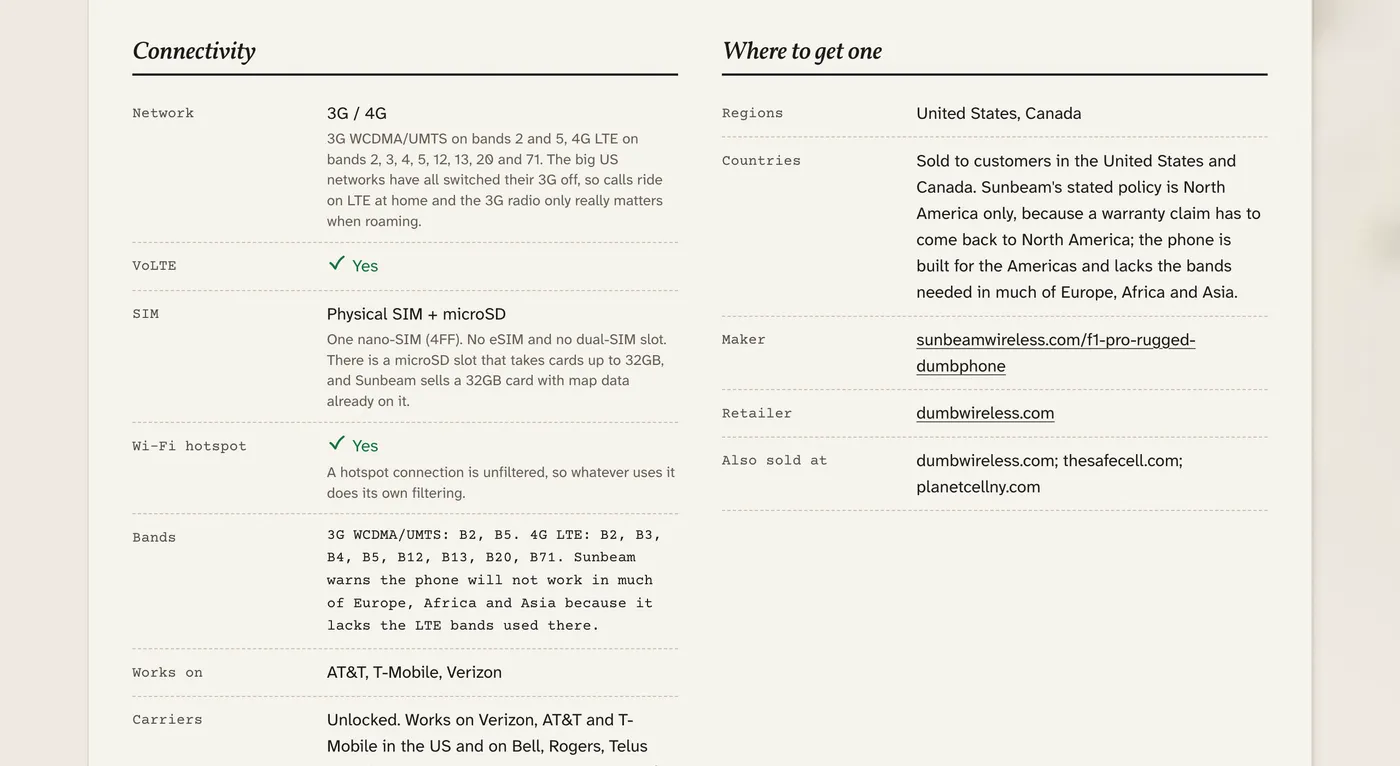
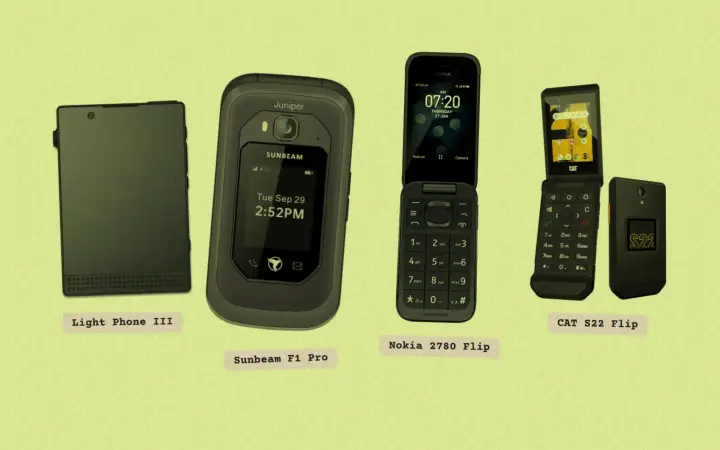
- The Light Phone III and the Sunbeam F1 Pro are listed by their makers for all three big carriers, though Light leaves out Verizon prepaid.
- Before you buy, dial *#06# for the IMEI, run it through your carrier's own checker, and read the maker's carrier table.
On T-Mobile, very likely. On AT&T, probably, if the phone’s exact model is on AT&T’s approved list. On Verizon, only if Verizon recognizes the phone, and a lot of small makers never get that far. That’s the order from easiest to hardest: T-Mobile and the carriers that run on its network accept the widest range of dumbphones, AT&T goes by model number, and Verizon checks every phone against its own records before it will turn a line on.
So before you buy, run the phone’s IMEI through your carrier’s own checker and read the maker’s carrier table. The database’s Verizon filter shows the phones whose makers list Verizon, and it’s the shortest of the three.
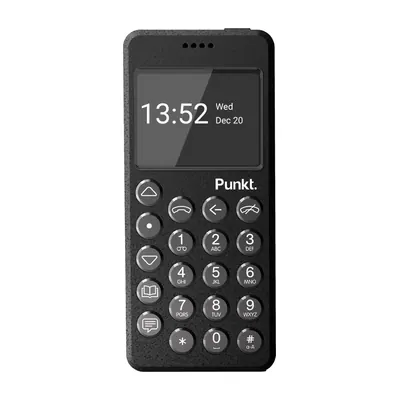
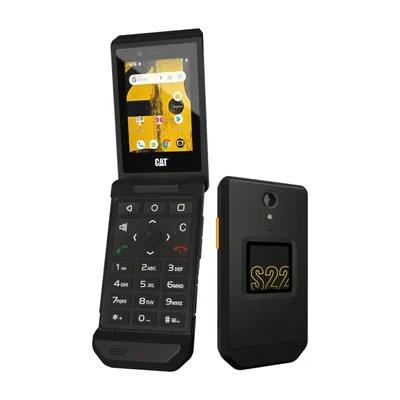
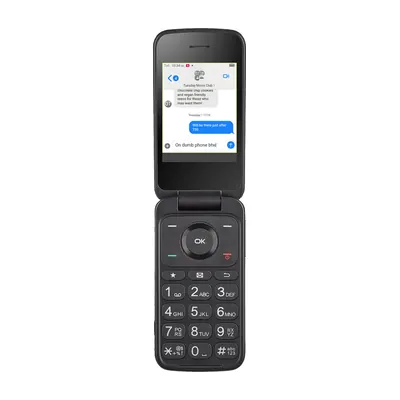
I’ve had to look this up for nearly every phone I’ve carried. The Punkt MP02 I used for a year was never going to work on Verizon, and Punkt says so in plain words. The Cat S22 Flip is a T-Mobile phone. The Dumbphone 2 in my pocket now skips the question, because dumb.co sells it with its own service on T-Mobile’s network and doesn’t let you bring another carrier.
Three things decide whether a phone works
A phone has to clear three separate bars, and a carrier can stop it at any one of them.
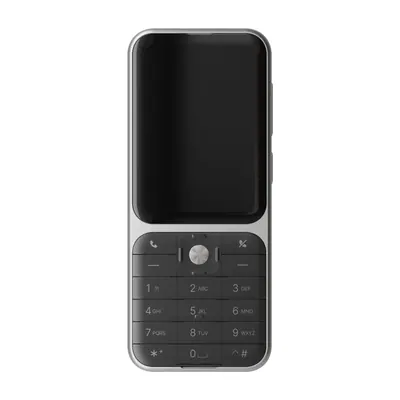
The first is bands, the radio frequencies the phone can hear. Each carrier runs LTE on its own mix of them, and a phone built for Europe or China often misses the ones American networks lean on. Verizon needs band 13. The Sidephone SP-01 is missing bands 13, 66 and 71, so Verizon is out before anyone checks a list. The imported Nokia 3210 4G is missing 2, 4, 12, 13, 66 and 71, which makes it a poor fit for any US line.
The second is VoLTE. The 3G networks are gone, so calls now travel over LTE, and both the phone and the carrier have to support it on that line. I went through how that played out in why old flip phones stop working. The VoLTE column in the database says yes, no, partial or unknown, and partial is specific: Punkt’s own table has the MP02’s VoLTE verified on AT&T and not supported on T-Mobile.
The third is the list. Each carrier keeps a record of the phones it has approved, and the checker on its website looks yours up by the IMEI, the identifying number every phone carries. This is where the three carriers differ most.
Why Verizon turns away the most phones
Verizon’s bring-your-own-device page asks for the IMEI and says your phone “must be unlocked and its hardware and software must be compatible with our mobile network.” In practice, compatible means Verizon has seen it. Makers get there through Verizon’s device certification program, which means lab testing and paperwork, and a lot of small phone companies haven’t done it. A phone Verizon hasn’t certified tends to come back as not compatible, even when its radio has every band Verizon uses.
You can see it in what the makers and sellers say themselves:
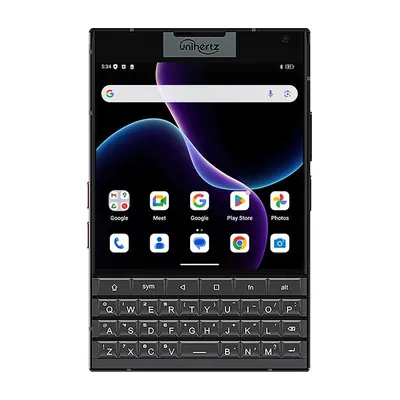
- Unihertz says its phones aren’t Verizon-certified, so a new Verizon SIM has to be activated in another phone first and then moved over. That goes for the Titan 2 and the Jelly phones.
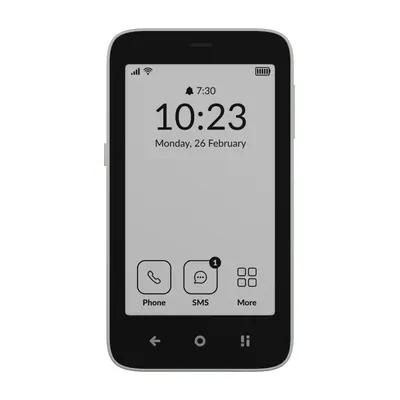
- Dumb Wireless, which sells the Mudita Kompakt in the US, says it works on Verizon only if you already have an active physical Verizon SIM.
- Light lists Verizon for the Light Phone III and the Light Phone II, but not Verizon prepaid and not NumberShare. Techless says much the same of the Wisephone II: postpaid Verizon only.
- The Mudita Pure has a low-radiation antenna that couldn’t pass the extra over-the-air tests AT&T and Verizon require, so neither would certify it.
That last one is worth sitting with. The testing is real, and a phone built to do something unusual can fail it for a decent reason.
AT&T goes by the exact model number
AT&T publishes a PDF of the phones it has tested and approved. The copy I’m reading was last updated March 27, 2026. It goes by model number, and it warns that the name on the box isn’t enough: two Galaxy S20 models work on AT&T and two others with the same name don’t. It also says, in its own words, “Models listed here are not guaranteed to work on the AT&T network.”
A few small phones made it on: the Punkt MP02, a Sunbeam F1, Unihertz’s Jelly 2 and Titan 2, Sonim’s XP3 and XP3plus, the Kyocera DuraXA Equip and DuraXE Epic, and the TCL Classic. Unihertz got two phones onto the list, and its own AT&T notice tells owners of every other Unihertz model to switch to T-Mobile or Verizon.
T-Mobile is where small makers start
T-Mobile has an IMEI checker too, but it’s the network the small makers build for first. AGM sells its US flips and keypad phones as T-Mobile-only. Unnecto says the Snap works on T-Mobile and not on AT&T or Verizon. The Cat S22 Flip, the Bigme HiBreak Pro Color and the Dumber Mini are all T-Mobile phones in the US.
Two catches. VoLTE can still go missing on a phone T-Mobile lets on, which is the MP02’s situation, and Sidephone warns that on carriers it isn’t certified with, VoLTE and data speeds can be limited. And a phone bought from T-Mobile or Metro may be locked to them: the TCL Flip 4 5G from Metro won’t take another network’s SIM.
Which phones in the database list each carrier
These come from the database’s “Works on” field, which only says yes when the maker or a retailer has said so in writing. A blank means nobody has said, which is different from no.
All three carriers
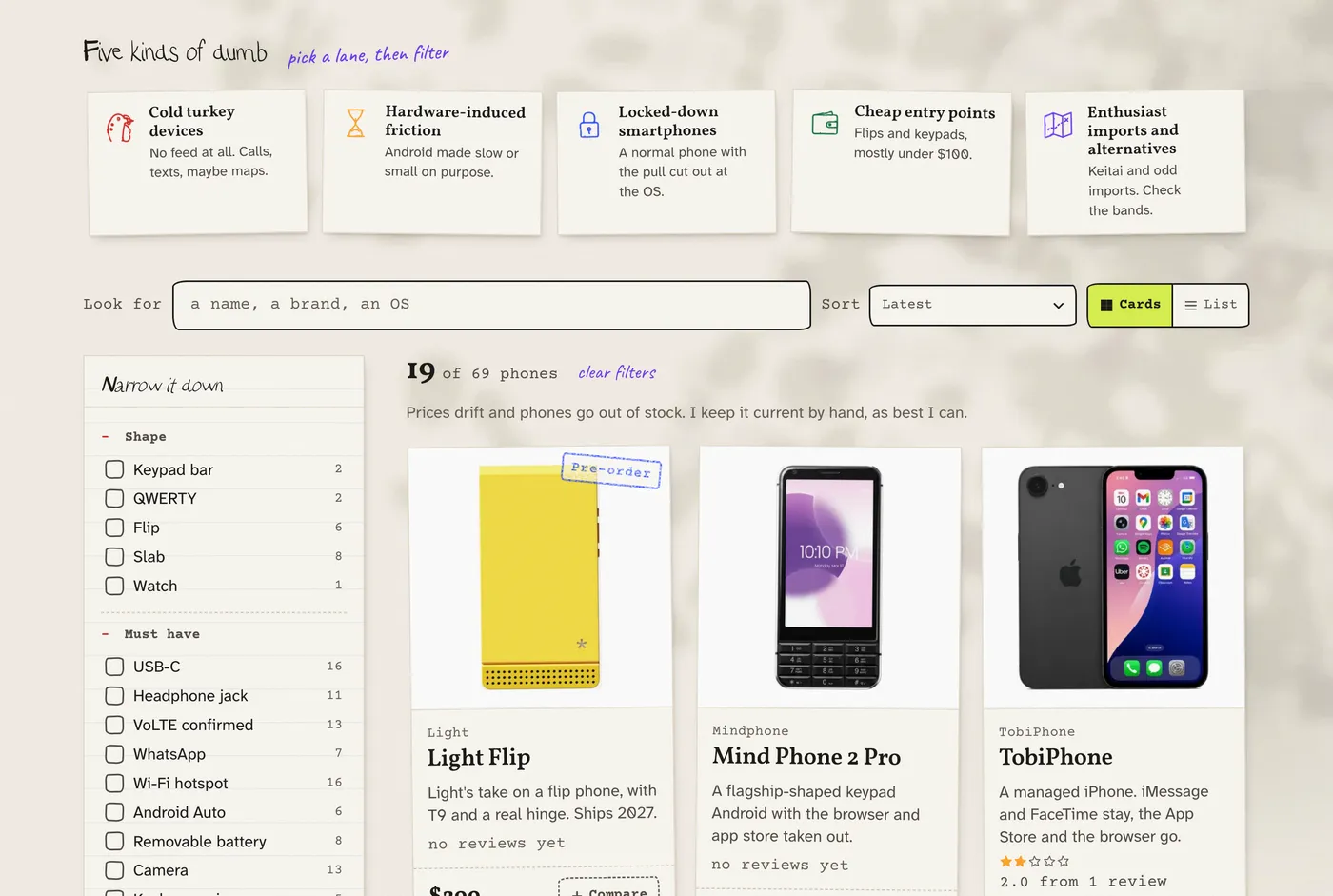
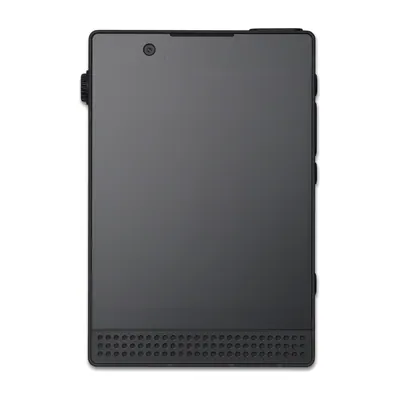
- Light Phone III and Light Phone II, with no Verizon prepaid and no NumberShare. The Light Flip is listed too, for when it ships in 2027.
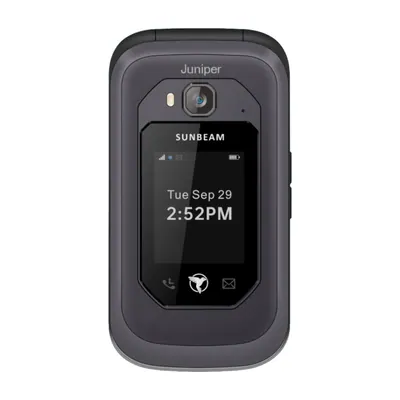
- Sunbeam F1 Pro and Sunbeam F1 Horizon, with most of their MVNOs. Sunbeam’s table marks Safelink, Spectrum, Visible, Xfinity and US Cellular as not working.
- Nokia 2780 Flip, which launched through all three. HMD has dropped it, so you’re buying used.
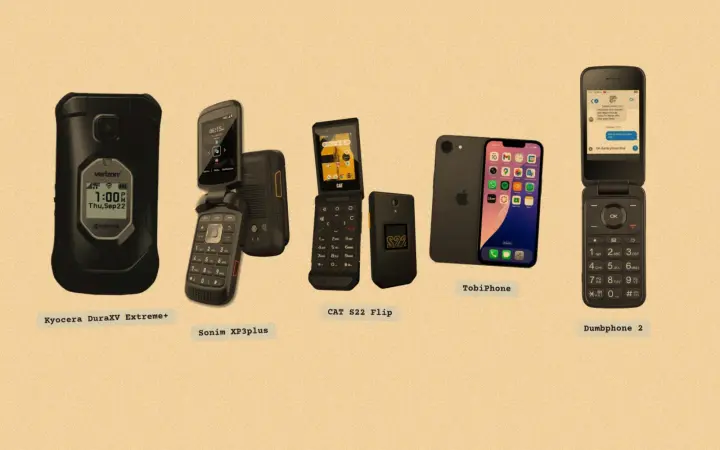
- Sonim XP3plus, which comes in separate carrier builds. Check which one you’re getting.
- Keyphone The Hybrid, whose maker lists a long run of MVNOs, Visible and Xfinity Mobile included.
- Unihertz Titan 2, with the Verizon activation catch above.
- Wisephone II, postpaid Verizon only, and TobiPhone, which is an iPhone underneath.
- iPhone 13 mini and the Minimal Phone, which stopped being sold new this month.
Verizon and T-Mobile
- The Unihertz Jelly Star, Jelly 2E and Jelly Max. The Jelly Max has no band 71, so T-Mobile’s 600MHz low band isn’t covered.
- Mind Phone 2 Pro, which Kosher Cell lists under both.
AT&T and T-Mobile
- Mudita Kompakt, with Verizon only on an already-active physical Verizon SIM.
- Punkt MP02, with VoLTE verified on AT&T and not on T-Mobile.
- Sidephone SP-01. T-Mobile is fully supported and AT&T can be patchy in places.
- Kyocera DuraXA Equip. Kyocera’s own list rules out Verizon and Visible.
- Vortex V3 Flip, sold for T-Mobile and through H2O Wireless on AT&T’s network.
One carrier only
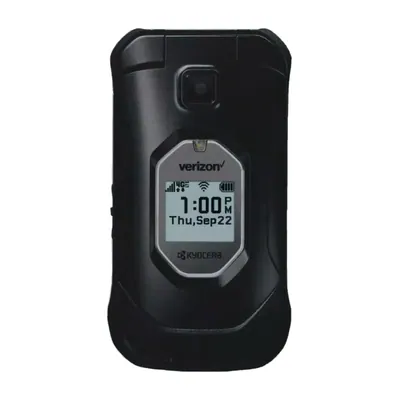
- Verizon: the Kyocera DuraXV Extreme+, the rugged flip Verizon still sells in a camera-free version.
- AT&T: the TCL Classic, which Cricket sells too, and the Kyocera DuraXE Epic, which specialist sellers still have new.
- T-Mobile: the Dumbphone 2 on dumb.co’s own service, the Cat S22 Flip, the TCL Flip 4 5G, AGM’s M8 Flip, M9, M10 and M11, the Unnecto Snap, the Bigme HiBreak Pro Color, the Balance Phone Pro, the Dumber Mini and the secondhand Mudita Pure.
Nothing listed yet
The imports mostly land here: the Japanese keitai flips, the Nokia keypad phones built on European bands, and the Duoqin phones from China. So do a few that haven’t shipped. The Commodore Callback 8020 hasn’t cleared FCC authorization, and Clicks names no US carriers for the Communicator. For any of these, the bands and the IMEI check are all you’ve got.
The smaller carriers that keep coming up
Read enough of the carrier notes and the same names repeat. If you run a dumbphone as a cheaper second line, you’ll probably end up on one of them.
- Mint Mobile. T-Mobile has owned it since May 2024. Light, AGM and Balance list it, Dumb Wireless lists it for the Mudita Kompakt, and Kyocera says the DuraXA Equip needs a SIM that’s already been activated before it’ll work on Mint.
- Noble Mobile. It’s powered by T-Mobile’s network, and it turns up on the lists for the Light phones, the Mudita Kompakt and AGM’s M10 and M11.
- US Mobile. It runs three networks under its own names, so the makers name the plan: Light lists Light Speed, Techless lists Dark Star, and Balance tells anyone on Warp to move.
- Ting and Tello. Light, Techless and Unnecto name Ting. Tello comes up for the Cat S22 Flip, the Wisephone II, the Balance Phone Pro and AGM’s M8 Flip.
- Visible, Xfinity Mobile and Spectrum Mobile. Visible is Verizon’s own brand, and Xfinity and Spectrum run on Verizon’s network. They’re also the names most often marked as not working, even on phones that work on Verizon itself.
- Straight Talk, Tracfone, Cricket, Consumer Cellular and Google Fi. Light rules out all five, and Balance rules out all but Google Fi. Kyocera and Keyphone list several of them as fine.
The pattern is that riding on a big network doesn’t make a small carrier accept the same phones. Look for your carrier by its own name.
How to check a phone before you buy
- Get the exact model number. AT&T’s Galaxy S20 example is the cautionary tale, and dumbphones have their own: the HMD Barbie Phone is two different phones sold under one name, and only the US one carries US bands.
- Get the IMEI. Dial *#06# and it shows on screen, or look under About in the settings. Buying used, ask the seller for it before you pay.
- Run it through your carrier’s checker. Verizon, AT&T and T-Mobile each have one on their bring-your-own-device pages. If you’re on a smaller carrier, use theirs.
- Read the maker’s own table. Sunbeam, Light and Kyocera all publish one, and every phone page in the database copies the carrier notes into its spec sheet, next to VoLTE.
- Buy where you can return it. Unihertz, for one, refuses returns over carrier compatibility.
What to do when your phone isn’t on the list
If you love the phone, change the line. A second number on a T-Mobile-based carrier will run more of the database than any other network, and it lets your old number stay on the smartphone while you find out whether the small phone sticks, which is the idea behind a two-week trial. The Dumbphone 2 is built around that idea: its middle plan is sold as a companion to a smartphone, and dumb.co warns that porting your old number over cancels the service on the smartphone.
If you’re staying on Verizon, start from the Verizon filter, or just the flips on it, and pick from what’s there. The SIM swap Unihertz describes is a workaround, and I wouldn’t buy a phone counting on it.
If the phone is close, ask the maker. Light says the Light Flip will be certified with the major US carriers before it ships, so for a phone that hasn’t shipped, the maker’s table is the one to watch.
And if none of it lines up, the free route is still there. The alternatives page has nine ways to make the phone you already own quieter, and none of them needs an IMEI check.
Questions people ask
- Why does Verizon say my unlocked phone isn't compatible?
- Verizon's checker looks the phone up by its IMEI, and a phone Verizon hasn't certified usually comes back as not compatible even if its radio covers Verizon's bands. Some makers, Unihertz among them, say a Verizon SIM activated in a certified phone first and then moved over will work. It's a workaround, and workarounds can break.
- Do dumbphones work on Visible, Xfinity Mobile or Spectrum Mobile?
- Often they don't, even though all three run on Verizon's network. Sunbeam's own table marks Visible, Xfinity and Spectrum as not working with its flips, and Light and Kyocera rule some of them out too. Look for your carrier by name in the maker's table, because the network underneath doesn't settle it.
- How do I find a phone's IMEI?
- Dial *#06# on the phone and it shows on the screen. It's also in the settings under About, on the box, and on a label under the battery if the battery comes out. If you're buying used, ask the seller for it before you pay and run it through your carrier's checker.
- Which flip phones work on Verizon?
- In the database, the Sunbeam F1 Pro, the Sunbeam F1 Horizon, the Nokia 2780 Flip, the Sonim XP3plus and the Kyocera DuraXV Extreme+ list Verizon, and the Light Flip is listed for when it ships in 2027. The DuraXV Extreme+ works on Verizon and nothing else. Run the IMEI through Verizon's checker anyway, since a used phone can turn up on the lost or stolen list.
The phones in this post
compare them side by side-
 Punkt. Punkt. MP02 (4G) $299+
-
 CAT (Bullitt, under license) CAT S22 Flip $168+
-
 dumb.co Dumbphone 2 $20
-
 Sidephone Sidephone SP-01 $299
-
 Unihertz Unihertz Titan 2 $490
-
 Mudita Mudita Kompakt $399
-
 Light Light Phone III $899
-
 Sunbeam Wireless Sunbeam F1 Pro $330+
-
 Kyocera Kyocera DuraXV Extreme+ (E4811) $140+
Read next
-
Phones
The best flip phones of 2026
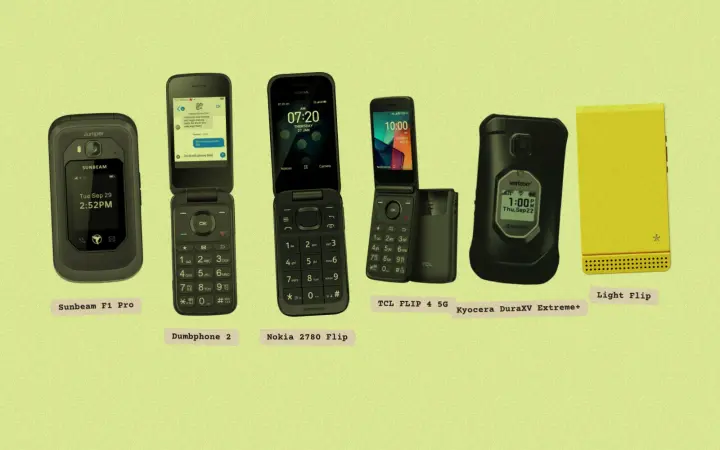
The flip phones that still work on AT&T, T-Mobile and Verizon in 2026, from a $99.99 TCL to the $359 Sunbeam F1 Pro, and the VoLTE question to ask first.
-
How-to
Keeping the group chat after you switch to a dumbphone
How to keep the group chat on a dumbphone: deregister iMessage, what RCS on iPhone changes, which small phones do group texts, and WhatsApp on a computer.
-
Work
The right small phone for your job
Which small phone fits your job, from rugged flips for job sites to locked-down smartphones for sales, and why gig work is the one job a dumbphone can't do.